
Find Washington Deed Records
Washington deed records are public documents held by the County Auditor in each of the state's 39 counties. The County Auditor serves as the official custodian of recorded property documents, including warranty deeds, quitclaim deeds, deeds of trust, liens, easements, and other instruments that affect real property. You can search deed records online through the Washington State Digital Archives or through individual county recording portals. For certified copies or older documents not yet digitized, contact the County Auditor directly in the county where the property sits. Most counties also offer public access terminals at their offices for in-person research at no charge.
Washington Deed Records Overview
What Washington Deed Records Contain
A deed record in Washington is a legal instrument that transfers ownership of real property from one party to another. These documents are recorded by the County Auditor and become part of the permanent public record for the county where the property sits. The grantor is the party conveying the property. The grantee is the one receiving it. Once a deed is recorded, it puts the public on notice that the transaction took place.
Washington deed records typically include the names of the grantor and grantee, a full legal description of the property, the county Assessor's parcel number, the signatures of the parties involved, and a notary acknowledgment confirming the signing was voluntary. The legal description is one of the most critical elements. Under Washington law, a street address alone is not sufficient. To be enforceable, a deed must contain either a metes and bounds description prepared by a licensed surveyor or a lot, block, and plat description that refers back to a previously recorded plat in that county's records. This standard was established in Martin v. Seigel, 35 Wn.2d 223 (1950).
Beyond ownership transfers, the recording system captures a wide range of property documents. Deeds of trust, easements, real estate contracts, liens, reconveyances, assignments, and restrictive covenants all pass through the County Auditor's office. The index of all recorded instruments is public. Most counties now make the index searchable online, and many provide document images as well.
The Washington State Archives has digitized a growing portion of historical land records and works with county offices to preserve older deed books, plat maps, and survey documents that predate modern recording systems.
Search Washington Deed Records Online
The Washington State Digital Archives is the best free starting point for searching deed records statewide. The collections portal includes a Land Records category covering multiple counties, Real Property Record Cards with photographs from the 1930s and 1940s, a Plats and Surveys collection, and Recorded Agreements and Contracts. You can search by party name, document type, year range, or browse by county. The Digital Archives was the first in the nation to preserve electronic records from both state and local government, representing a major resource for property research.
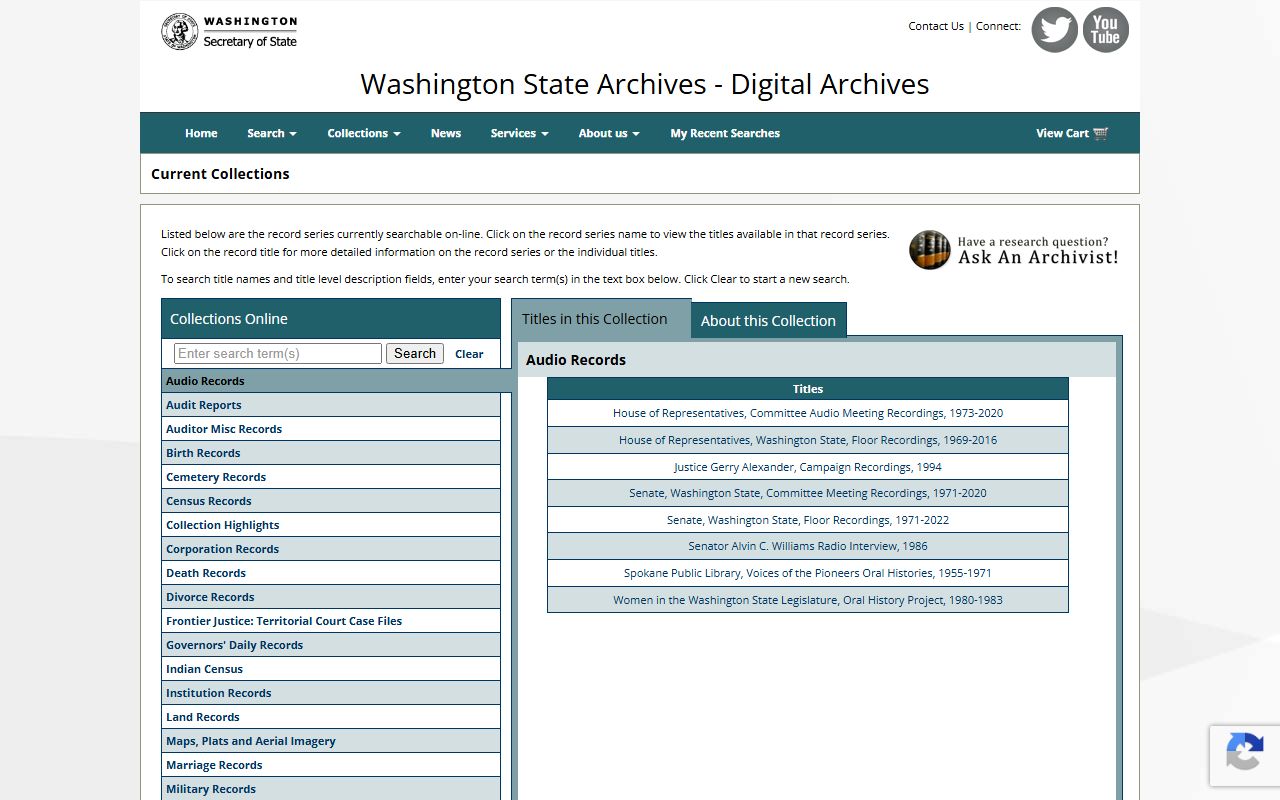
The Digital Archives collections portal at digitalarchives.wa.gov lets you search Land Records, Real Property Record Cards, Plats and Surveys, and other recorded deed documents across Washington's 39 counties.
Individual counties also operate their own online search systems. King County provides the LandmarkWeb portal at recordsearch.kingcounty.gov for recorded documents going back to 1991. Spokane County uses a dedicated recording search at recording.spokanecounty.org. Pierce County offers ARMS Web at armsweb.co.pierce.wa.us. Snohomish County has its own recorded documents search. Thurston and Benton counties each offer EagleWeb portals for real-time deed lookups. Grant County uses a Tyler Technologies recorder system. Check each county's auditor page to find their current online search tool.
For records that predate online systems, the Washington State Archives operates five regional branches: the Central, Eastern, Northwest, Puget Sound, and Southwest Regional Branches. Each holds collections transferred from county offices in their region. The State Archives homepage at sos.wa.gov has contact information and collection guides for each branch.
Washington County Auditors and Deed Records
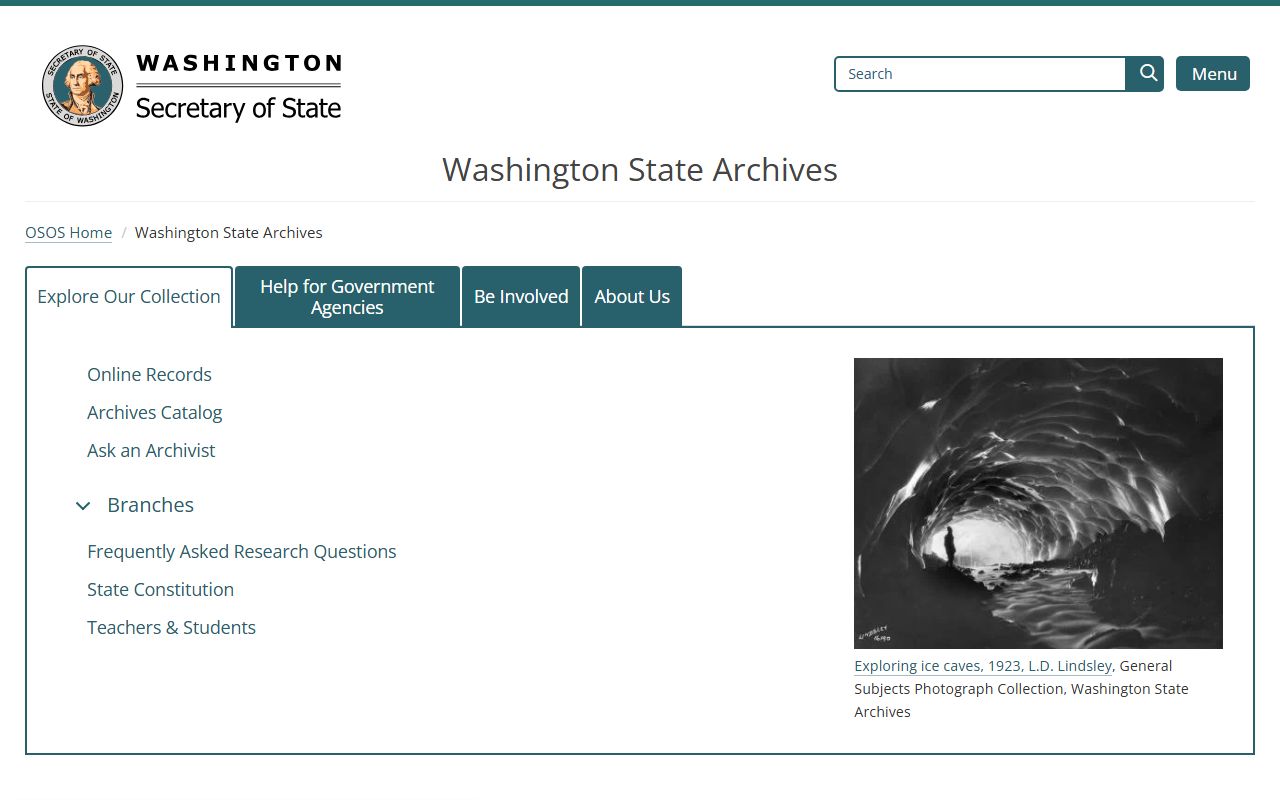
The Washington State Archives at sos.wa.gov holds historical land records transferred from county offices, providing access to deed books and property documents that predate modern digital recording.
In Washington, the County Auditor in each of the 39 counties is the designated "Custodian of Records" under state law. The auditor's recording division receives property documents, verifies they meet formatting standards, assigns recording numbers, indexes them for public retrieval, and retains them permanently. Under RCW 65.08.070, the first recorded conveyance of real property takes priority over a previously executed but unrecorded conveyance of the same property. This "race to record" rule makes timing of recording legally significant in Washington.
The Washington State Association of County Auditors (WSACA) represents all 39 elected county auditors and sets professional standards for recording practices statewide. The association hosts an annual conference covering recording law updates, technology changes, and best practices. WSACA members follow uniform procedures under RCW 36.22 and RCW Title 65 for how documents must be accepted, indexed, and made available to the public.
WSACA represents the 39 county auditors across Washington who serve as official custodians of deed records and all other property documents recorded in their counties.
The auditor's office cannot give legal advice. Preparing a deed correctly is the responsibility of the document preparer, not the recording officer. The auditor verifies that proper fees are paid, the document title is listed, indexing information is complete, and the document meets formatting requirements before acceptance. Under RCW 65.08.095, recording constitutes legal delivery of the document.
Types of Deed Records in Washington
Washington law recognizes three main deed types for property conveyances. Each offers a different level of warranty protection to the grantee. Knowing the deed type in a recorded document can tell you a great deal about the nature of the transaction and what protections the buyer received from the seller.
The Statutory Warranty Deed under RCW 64.04.030 is the most buyer-protective deed in Washington. With this deed, the grantor covenants that they own the property and have the right to convey it, that no one else is in possession with a claim, that there are no encumbrances beyond those stated, and that they will defend the grantee's title against all lawful claims. This is the standard deed type used in most residential real estate sales in Washington.
The Bargain and Sale Deed under RCW 64.04.040 provides more limited protection. The grantor only warrants against defects that arose during their period of ownership. Banks and lenders often use this deed type after a foreclosure when they need to convey property they acquired through the foreclosure process and cannot make broader warranties about the full title history.
The Quitclaim Deed under RCW 64.04.050 carries no warranties at all. The grantor simply transfers whatever interest they may have in the property without any promises. Quitclaim deeds are common in transactions between family members, in divorce settlements to convey one spouse's interest to the other, and in situations where parties want to clear title questions or confirm that one party no longer claims an interest.
All three deed types must meet the same basic requirements under RCW 64.04.020: the deed must be in writing, contain a proper legal description, be signed by the grantor, and the grantor's signature must be notarized. Before a deed can be recorded, the parties must also complete a Real Estate Excise Tax Affidavit stating the purchase price or the basis for any exemption from the tax.
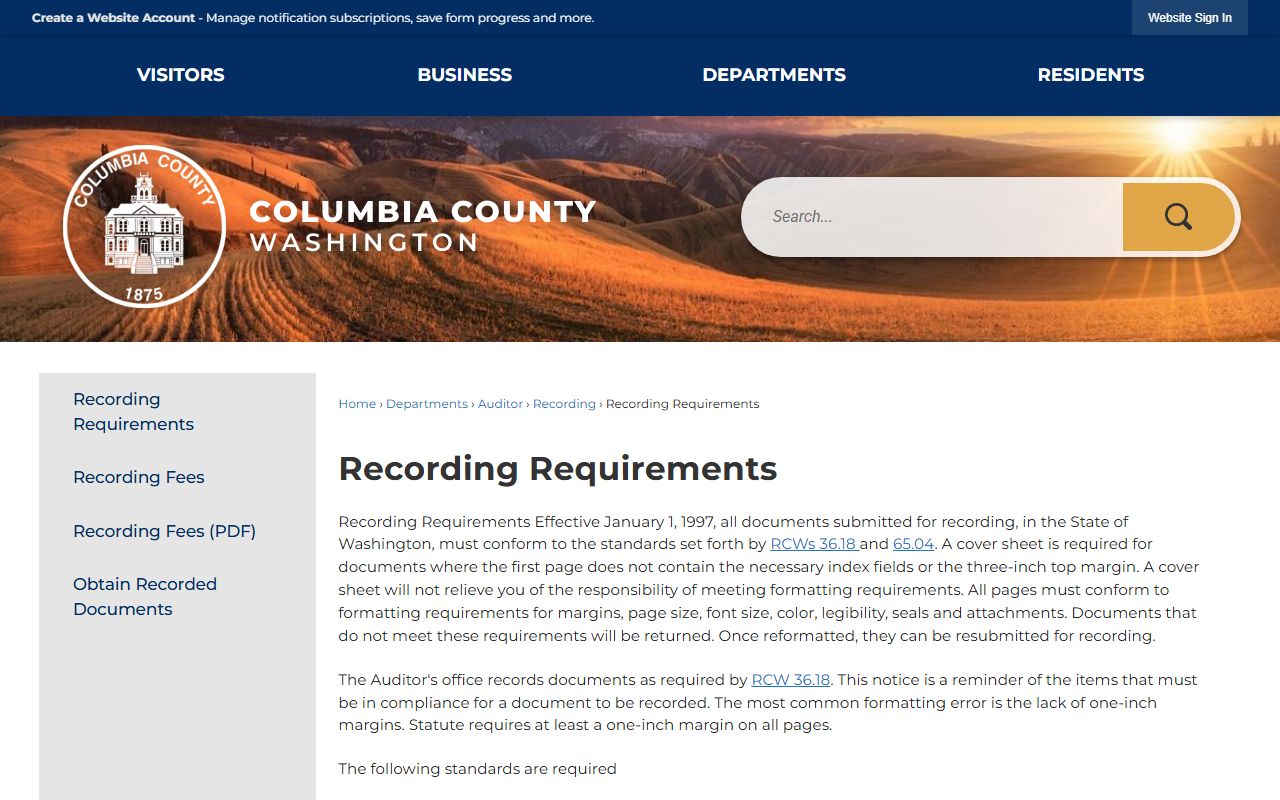
Columbia County's recording requirements page shows the formatting standards that all 39 Washington counties apply when reviewing deed submissions under RCW 36.18 and 65.04.
Washington Deed Recording Fees
Recording fees in Washington are set by the state legislature under RCW Chapters 36.18 and 36.22 and apply uniformly across all 39 counties. As of January 1, 2024, the standard fee to record a deed is $303.50 for the first page, plus $1.00 for each additional page. A Deed of Trust costs $304.50 for the first page due to an additional $1.00 archive fee.
The fee structure breaks down into several components. The base fees cover State and Local Historical Preservation ($9.00), Local Recording Functions ($10.24), and a combined State and Local Affordable Housing surcharge ($184.26). The total includes a $183 housing affordability surcharge and a $100 Covenant Homeownership surcharge that fund affordable housing programs, homeless prevention services, and down-payment assistance initiatives across the state. These surcharges were added through legislation amending RCW 36.18 and represent a significant increase over prior fee levels.
Starting July 27, 2025, assignments or substitutions of previously recorded deeds of trust increased to $301.00 for the first page. This change eliminated a prior fee exemption that had allowed these documents to be recorded for just $18.00. If a deed does not meet formatting requirements and needs an Emergency Non-Standard cover sheet, an additional $50.00 surcharge applies on top of standard fees.
Real estate excise tax (REET) applies separately from recording fees when property changes hands. For most residential sales under $525,000, the combined REET rate is 1.60%, composed of a 1.1% state portion and 0.5% local portion. Higher-value transactions face progressively higher rates up to approximately 3.5%. Transfers by inheritance or bequest are exempt from REET. Copies of recorded deed documents from the County Auditor typically cost $1.00 per page for uncertified copies.
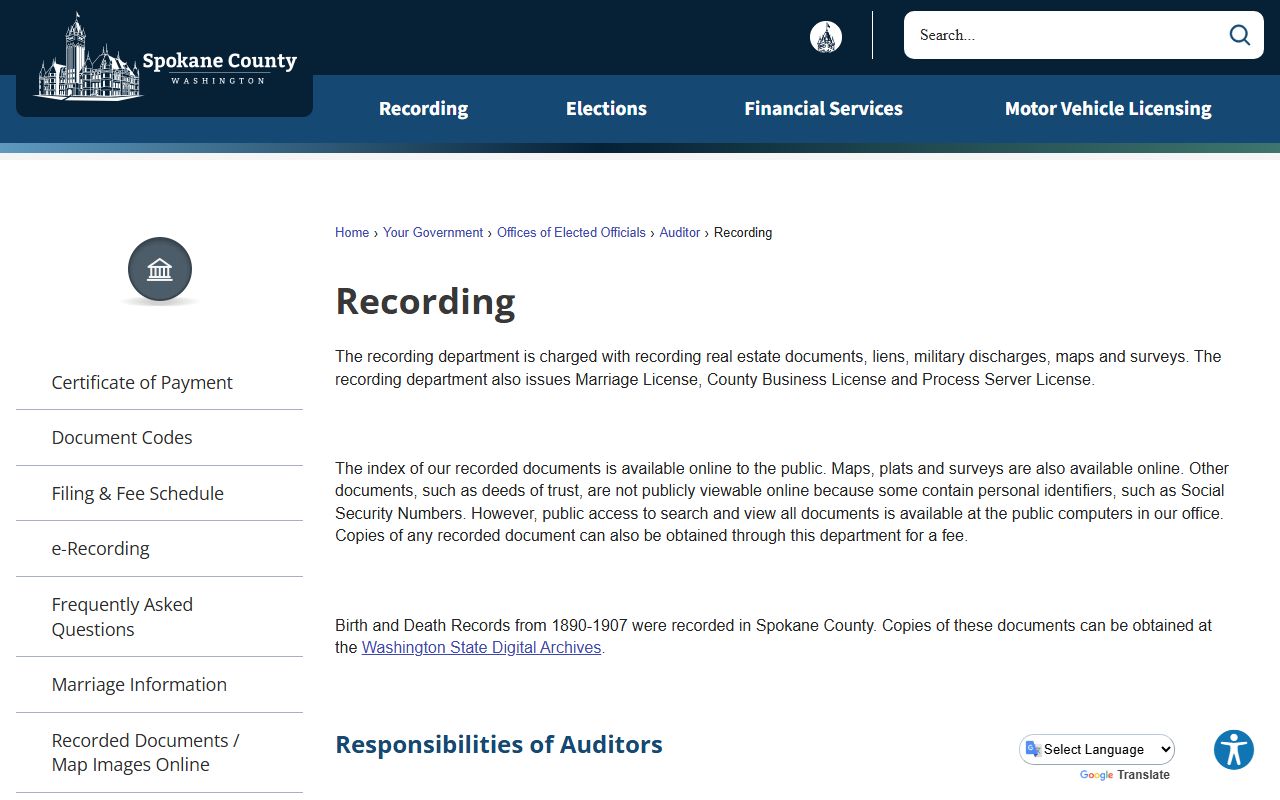
Spokane County's Recording Department page explains how county auditors across Washington function as Custodians of Records under RCW statutes, including how recording fees are collected and how deed documents are processed.
Washington Deed Document Requirements
All documents submitted for recording in Washington must meet formatting standards established under RCW 65.04 and RCW 36.18, effective January 1, 1997. These standards apply uniformly across all 39 counties. A deed that does not meet the requirements will be returned for correction or may go through with an Emergency Non-Standard surcharge if a cover sheet is used in lieu of reformatting.
The first page of a deed must carry a 3-inch margin at the top. All other margins, on all pages, must be at least 1 inch. Within the top margin or immediately below it, the first page must include the return address, the document title, the names of the grantor and grantee with page references if more names appear later in the document, an abbreviated legal description, and the Assessor's property tax parcel number where applicable. Nothing may be placed in any margin area except the return address in the top margin of the first page.
Documents must be legible and capable of producing a clear image when scanned. The ink must be capable of being reproduced. Page size cannot exceed 8.5 by 14 inches for deeds, though maps, plats, and surveys may use larger formats. Type must be at least 8-point font. Nothing may be stapled, taped, or glued to any page, including notary seals. Notary acknowledgments should be stamped or printed directly on the document.
The most common formatting mistake is insufficient margins. Side and bottom margins must be clear of any content, including bar codes, company logos, order numbers, page numbers, or notary seals. When a document cannot easily be reformatted to meet requirements, a cover sheet may be used but will add $1.00 to the recording fee. Emergency Non-Standard processing adds $50.00.
Public Access to Washington Deed Records
Washington deed records are public records under RCW Chapter 42.56, the Washington Public Records Act. Anyone can request to inspect or copy deed records held by a County Auditor. You do not need to state a reason. No identification is required to inspect records. The agency cannot ask why you are requesting documents under RCW 42.56.080.
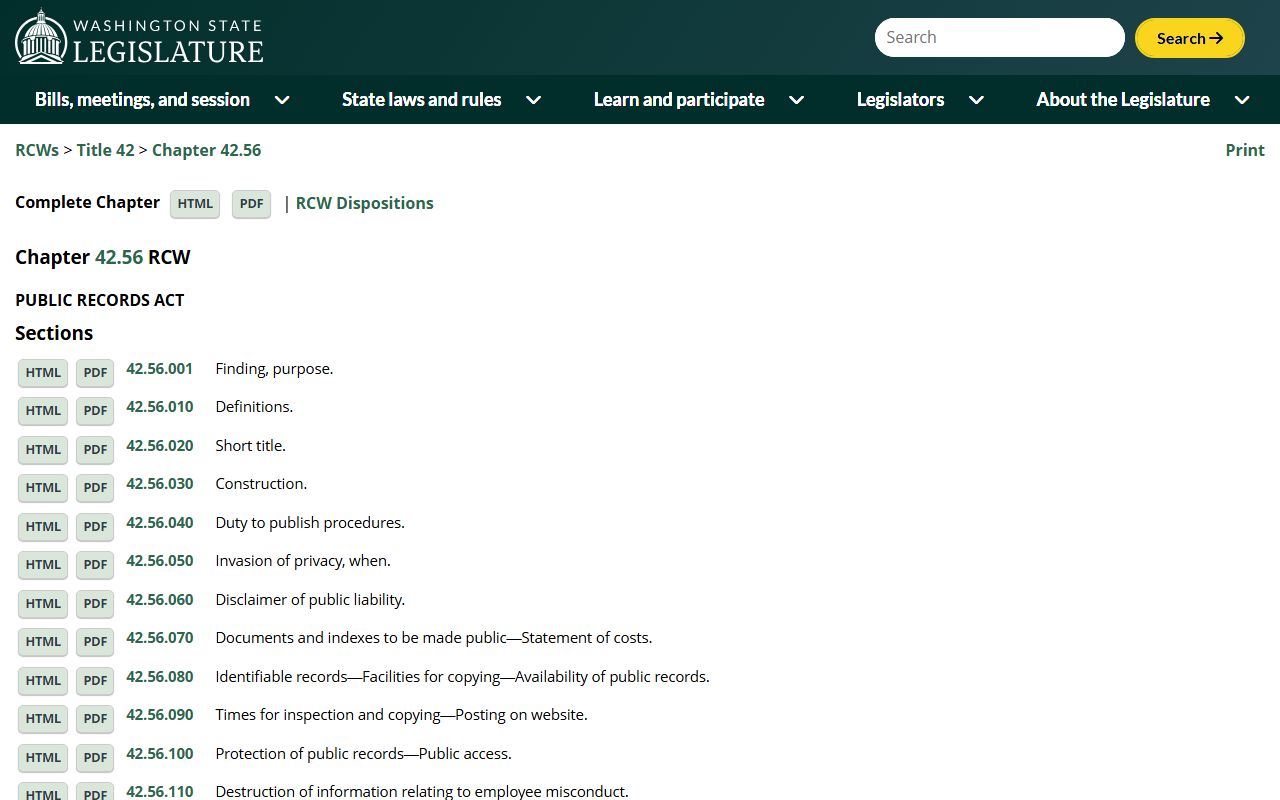
RCW Chapter 42.56, the Washington Public Records Act, governs public access to deed records and all other government-held documents maintained by county auditors across the state.
Under the Act, agencies must respond to records requests within five business days. They can provide the records, give you a link to where the records are available online, acknowledge the request with an estimated fulfillment date, or deny it with a specific statutory justification. Inspection of records is free. Copying fees are typically $0.15 per page for standard documents, though recorded deed copies from the auditor follow their own schedule, usually $1.00 per page for uncertified copies.
Some documents, such as deeds of trust, may not be viewable online because they can contain personal identifiers like Social Security Numbers. These documents are still accessible in person at the County Auditor's office using public access terminals. Records involving Social Security Numbers or account numbers are redacted from public copies consistent with state privacy rules.
Washington real estate law is primarily found in RCW Title 64 (Real Property and Conveyances), RCW Title 65 (Recording, Registration and Legal Publication), and RCW Title 61 (Mortgages, Deeds of Trust and Real Estate Contracts). The WSACA Recording Manual provides detailed guidance on how auditors apply these statutes in their daily recording operations. The Washington State Department of Licensing oversees real estate professionals through dol.wa.gov.
The Washington Department of Licensing administers real estate broker licensing under RCW 18.85, ensuring qualified professionals handle property transactions that generate recorded deed documents in county auditor offices.
Browse Washington Deed Records by County
Each of Washington's 39 counties has a County Auditor who records and maintains deed records for property in that county. Select a county below to find the recording office's contact details, online search portals, and resources for deed records in that area.
View All 39 Washington Counties
Washington Deed Records by City
Deed records are filed with the County Auditor in the county where the property sits, not with the city. If you know the city, use the links below to find the right county recording office and search tools for that area.